How Big Do Oscar Fish Get? Real Tank Size Requirements
How large do Oscar fish grow, how fast do they grow, and what tank size do they really need? A Malaysia-focused guide using cm, litres and common kaki tank sizes.
Written by Eu C., a Malaysia-based aquarium hobbyist and editor of Akuarium.my.
Guide section
Freshwater Fish
Oscar care and type guides for Malaysian home aquarium planning.
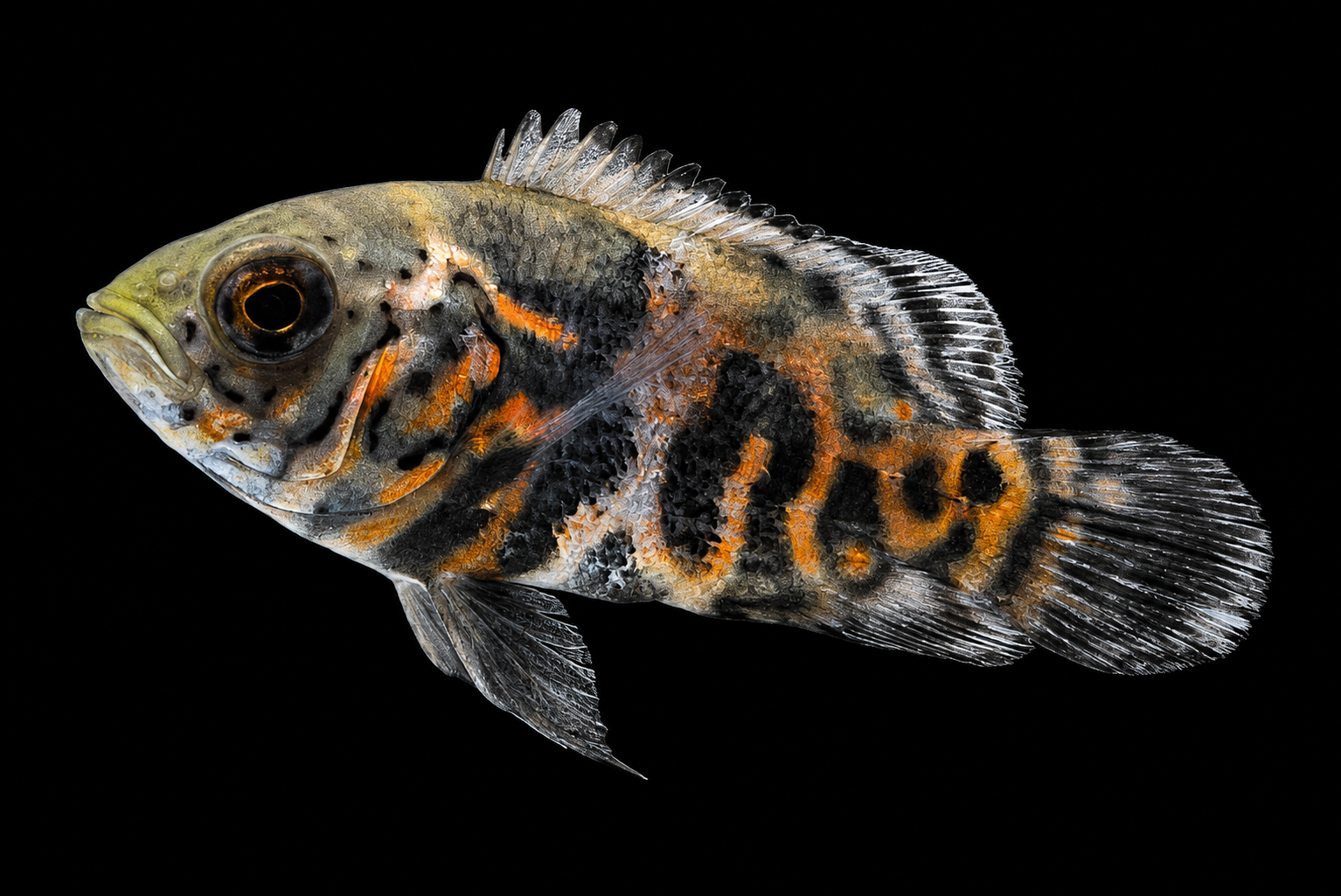
An Oscar is most misleading when it is still a 5 cm juvenile in a fish shop.
It looks small, and an ordinary aquarium appears large enough. That stage does not last.
Adult Oscar fish commonly reach about 25 to 35 cm in home aquariums, while verified species records show that exceptional fish can exceed 40 cm. Most rapid growth happens during the first year, so the long-term aquarium must be chosen for the adult fish, not the juvenile you bring home.
The real question is not:
Which tank can hold this small Oscar today?
It is:
When this becomes a thick-bodied adult cichlid that eats heavily and produces a high bioload, will my tank, filter and maintenance routine still be enough?
Many Oscar keepers use “about one inch per month” as a rough juvenile growth reference. Some well-kept fish can approach 25 to 30 cm within roughly a year, while others grow more slowly.
That rule is useful as a warning, not a deadline.
Food quality, feeding frequency, water quality, usable space, health, stress and genetics all affect growth. An Oscar growing more slowly than another fish is not automatically being kept badly. At the same time, forcing faster growth through heavy feeding is not the same as providing better care.
For a broader care overview, read our Oscar fish guide for Malaysian home aquariums. To compare colour varieties, see our types of Oscar fish guide. For community planning, review seven Oscar tank mate options and their real risks.
Quick Answer
| Question | Practical answer |
|---|---|
| How large is an adult Oscar? | Commonly about 25–35 cm in captivity, although exceptional fish can grow larger |
| Do Oscars grow one inch per month? | Some juveniles may approach that rate, but it is not a guarantee |
| When is growth fastest? | Usually during the first year |
| Is a 3-foot tank a permanent home? | I would not use an ordinary 3-foot tank as the long-term home for an adult Oscar |
| What would I consider for one adult? | A 4 × 2 × 2 foot tank is the smallest local format I would seriously consider, while a 5 × 2 × 2 foot tank is a more comfortable long-term target |
| What about two Oscars? | Plan for a longer and wider system, usually around 6 feet or larger, plus a backup plan if they become incompatible |
| Will a small tank safely keep an Oscar small? | No. A small tank is not a safe size-control method |
| Is total litre capacity enough to decide? | No. Length, front-to-back width, filtration and maintenance capacity all matter |
My view is straightforward:
- A 3-foot tank may hold a juvenile temporarily, but it is not my adult plan
- A narrow 4-foot tank is not equal to a 4 × 2 × 2 foot tank
- For one adult Oscar, 4 × 2 × 2 feet is the minimum local format worth serious consideration, not a generous target
- If the space and budget allow it, 5 × 2 × 2 feet is the better long-term direction
- Two Oscars are not a simple “double the litres” calculation
- Slower growth is not automatically failure, but deliberately restricting growth with a small tank is not responsible planning
How Big Does an Adult Oscar Really Get?
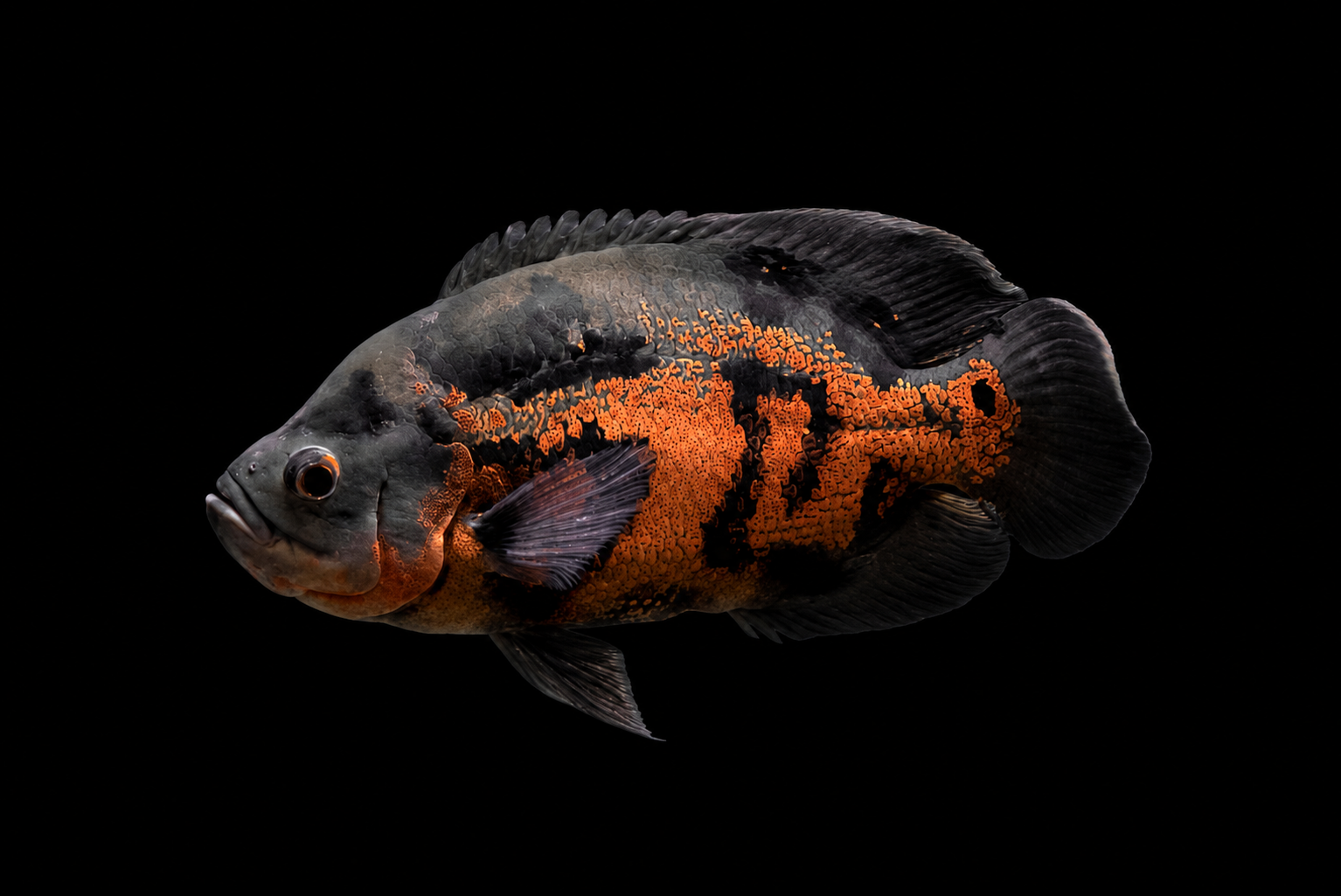
The Oscar’s scientific name is Astronotus ocellatus.
In home aquariums, many adult Oscars finish around 25 to 35 cm. FishBase records a maximum total length of 45.7 cm for the species, although fish at that extreme are not the ordinary outcome in a home tank.
That distinction matters.
Common adult size
The common captive range is the useful number for most keepers planning an aquarium.
A 30 cm Oscar is not just a thin 30 cm line. It becomes deep-bodied, thick and heavy. It needs room to turn without scraping the glass or constantly meeting hard decor.
Maximum recorded size
A maximum record shows what the species can achieve. It does not mean every Tiger, Red, Albino or Lemon Oscar will reach 45 cm.
I would not use an extreme record to frighten people, but I would also never plan for an Oscar as if 25 cm were a guaranteed upper limit.
The responsible assumption is that the small juvenile can become a fish around 30 cm or larger.
Colour varieties do not remove that requirement. Tiger, Red, Albino and Lemon are aquarium-trade colour forms of the same species, not miniature Oscars.
Do Oscars Really Grow One Inch per Month?
“One inch per month” is one of the most repeated Oscar growth rules.
One inch is about 2.54 cm.
The value of that rule is simple: it reminds a new keeper that a 5 cm juvenile can outgrow a temporary setup surprisingly quickly.
It should not become a growth target.
Some juveniles may grow close to that rate during their fastest period. Others grow more slowly because of genetics, starting age, food intake, water quality, health or stress. A fish bought at a shop also has an unknown age, so counting exact growth by calendar month can be misleading.
I would never judge an Oscar only by whether it reaches a specific centimetre figure on schedule.
A more useful monthly record includes:
- approximate body length
- body depth and condition
- appetite
- activity
- ammonia and nitrite
- nitrate trend
- whether the fish can turn comfortably
- whether aggression or stress is increasing
- whether the filter is still keeping up
If those conditions are good, there is no reason to chase another keeper’s growth rate.
Heavy feeding may increase waste faster than it increases healthy body length. It can lead to leftover food, higher ammonia pressure, faster nitrate accumulation and an overweight fish.
An Oscar is a pet, not a farm fish being pushed toward a production target.
A Practical Oscar Growth Timeline
This timeline is a planning guide, not a promise. Growth varies widely, and shop juveniles may not all be the same age.
| Stage | Rough planning range | What usually changes |
|---|---|---|
| Small shop juvenile | About 5–8 cm | Looks manageable in a small aquarium |
| Several months later | About 10–18 cm | Appetite, body depth and waste increase quickly |
| Around the first year | About 20–30 cm | Many temporary tanks become clearly inadequate |
| Around 1–2 years | About 25–35 cm | The fish approaches adult length and continues to bulk up |
| Mature adult | Length growth slows | The body can continue becoming deeper and heavier |
The most important lesson is not whether an Oscar reaches 10, 12 or 15 cm by one exact month.
It is that the upgrade window can be much shorter than a new owner expects.
Buying a large permanent tank first is usually easier and cheaper than buying several temporary tanks, stands and filters in sequence.
Five Factors That Affect Oscar Growth
1. Genetics
Two Oscars can receive the same care and still finish at different sizes.
Parental size, breeding line and individual metabolism all contribute. Colour does not reliably predict a smaller adult fish.
A slowly growing Oscar is not automatically proof of poor care.
2. Food quality and feeding
A quality pellet formulated for large cichlids can provide a consistent base diet. Suitable clean supplementary foods can add variety.
What I would not do is treat “more food” as the complete answer to slow growth.
Overfeeding increases:
- uneaten food
- faeces
- mechanical filter load
- ammonia production
- nitrate accumulation
- obesity and digestive pressure
Unknown feeder fish are also unnecessary for normal Oscar growth and can add avoidable disease and nutrition risks.
3. Water quality
Oscar fish eat heavily and produce heavy waste.
Ammonia and nitrite should remain at zero. Nitrate, oxygen and stability also need active management.
Poor water quality may reduce appetite, increase stress and leave the fish using energy to cope with the environment instead of maintaining good condition.
Clear water alone is not proof that the water is safe. A proper aquarium test kit is far more useful than judging only by appearance.
4. Real usable space
The capacity printed for a tank is not the same as usable swimming space.
Actual water volume is reduced by:
- leaving space below the rim
- substrate
- wood and rocks
- internal filters or overflow sections
- large decorations
For an Oscar, front-to-back width matters because an adult fish must turn its deep body comfortably.
A long, wide aquarium is more useful than a tall, narrow aquarium with a similar litre figure.
5. Long-term stress and health
Crowding, incompatible tank mates, frequent environmental changes, disease and repeated loss of appetite can all affect growth and condition.
A fish does not need visible bite wounds to be under stress.
Hiding constantly, refusing food, crashing into the glass or being unable to turn normally are all reasons to review the entire setup, not just the feeding amount.
Real Oscar Tank Sizes in Malaysia
In Malaysia, aquariums are commonly described as 3 kaki, 4 kaki or 5 kaki.
That label usually tells you the approximate length only. It does not guarantee the width, height or litre capacity.
The examples below are common dimensions, not universal specifications. Always measure the actual tank before buying.
| Common description | Example dimensions | Gross theoretical volume | My long-term view |
|---|---|---|---|
| 3-foot tank | 90 × 45 × 45 cm | About 180 L | Temporary grow-out for a juvenile, not my permanent adult plan |
| Narrow 4-foot tank | 120 × 45 × 45 cm | About 240 L | Longer, but the 45 cm width is still restrictive for a large adult |
| 4 × 2 × 2 foot tank | About 122 × 61 × 61 cm | About 450 L | The smallest common local format I would seriously consider for one adult |
| 5 × 2 × 2 foot tank | About 152 × 61 × 61 cm | About 565 L | A more comfortable long-term direction for one adult |
| 6-foot wide system | Depends on custom dimensions | Depends on specification | More realistic for two Oscars or additional large tank mates |
Gross volume is not real operating volume
A 4 × 2 × 2 foot tank calculates to roughly 450 L when filled completely.
In real use, it is not filled to the edge. Substrate, wood and equipment also displace water, so the operating volume is lower.
That is why I would not make a decision from the litre figure alone.
Why front-to-back width matters
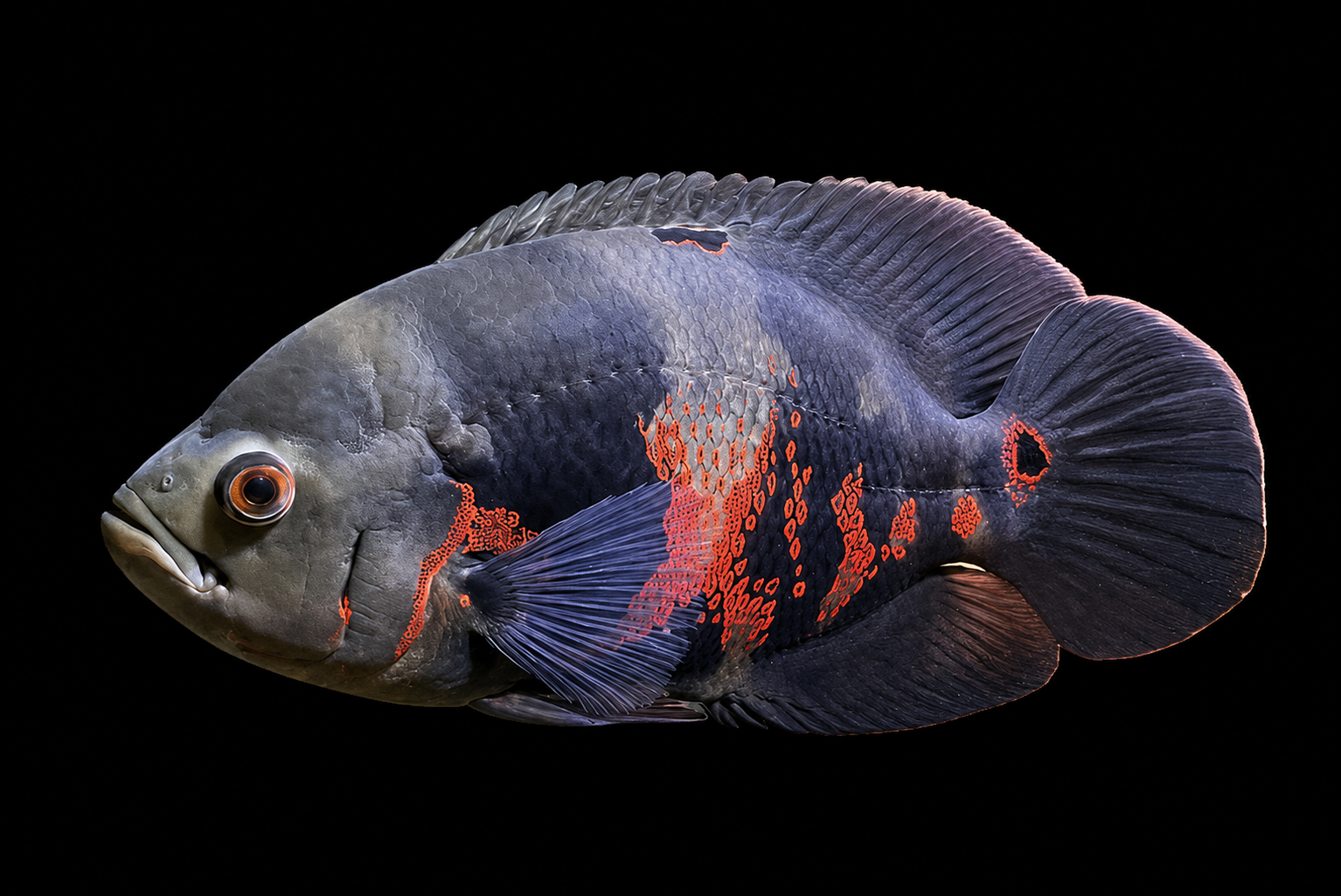
A large adult Oscar may be close to 30 cm long and has a deep body.
A standard narrow 4-foot tank can look large because of its length, but a 45 cm front-to-back width gives less turning room than a 4 × 2 × 2 foot tank with about 61 cm of width.
For this fish, the difference between:
4 feet longand:
4 × 2 × 2 feetis substantial.
One adult Oscar
I would not use an ordinary 3-foot aquarium as the permanent home.
For one adult, a 4 × 2 × 2 foot tank is the smallest common Malaysian format I would seriously consider. It offers useful width and much more water than a narrow 4-foot tank, but it is still a starting point rather than a luxury setup.
Where space, floor loading and budget allow, a 5 × 2 × 2 foot aquarium gives a more comfortable long-term footprint.
Two Oscars
Two Oscars require more than extra litres.
You also need:
- room for two deep adult bodies
- enough distance to retreat
- visual barriers
- substantially more filtration
- a plan for feeding competition
- a separate tank or rehoming plan if they become incompatible
Two juveniles growing up together are not guaranteed to remain peaceful adults.
For a pair or two unproven Oscars, I would look toward a 6-foot system with at least about 2 feet of width, and I would still keep a separation plan.
Oscar with tank mates
Every large tank mate adds:
- adult body mass
- territory pressure
- food competition
- solid waste
- oxygen demand
- quarantine and rehoming difficulty
The question is not only whether the tank mate is too large to swallow.
The whole aquarium must support all fish at adult size.
Will a Small Tank Stop an Oscar from Growing?
“Fish only grow to the size of their tank” is one of the most dangerous half-truths in aquarium keeping.
A cramped aquarium can contribute to poor condition and impaired growth. That does not make it a safe way to keep an Oscar small.
The practical problems include:
- insufficient turning and swimming space
- faster waste accumulation
- less stable water parameters
- chronic stress
- reduced natural behaviour
- greater difficulty maintaining oxygen and water quality
A fish remaining alive in a small tank does not prove that the tank is suitable.
I would also avoid repeating dramatic claims that are not well supported, such as saying the organs continue growing until they crush the body, or that every small tank accumulates a special growth-inhibiting hormone.
The useful conclusion is simpler:
Inadequate space, poor water quality, weak nutrition and chronic stress can prevent an Oscar from developing normally. That is a welfare problem, not a size-control strategy.
Why a Large Oscar Needs Serious Filtration
Oscar tank size is not only about swimming room.
An adult Oscar is a high-bioload fish. It eats larger food, breaks pieces apart and produces a large amount of solid waste.
A tank can be physically large enough and still fail because the filtration and maintenance routine are too weak.
Do not trust the maximum tank label blindly
A filter marketed for “up to 500 L” is not automatically enough for a heavily stocked 450 L Oscar tank.
Real performance changes with:
- media arrangement
- hose length
- head height
- clogged media
- actual flow after installation
- fish number and size
- feeding amount
- cleaning frequency
I would not choose an Oscar filter by matching the advertised maximum capacity exactly.
Our aquarium filter guides can help explain the main filter types, but the final system still has to be sized conservatively for a large messy cichlid.
Canister or sump?
Both can work.
A canister filter can suit a home aquarium that does not have a drilled overflow or sump cabinet. A sump can provide more media and easier equipment access, but it needs appropriate design, overflow safety and maintenance.
There is no universal winner.
The important rule is:
Design the filtration for the adult Oscar and its final bioload, not for the 5 cm juvenile in the shop.
Test the water instead of guessing
Water can look clear while ammonia, nitrite or nitrate is becoming a problem.
As the Oscar grows, use actual test results to adjust:
- water-change frequency
- water-change volume
- filter maintenance
- feeding amount
- total stocking level
If the water becomes dirty unusually quickly, our guide to why aquarium water gets dirty fast explains the main causes.
A Reality Check Before Buying an Oscar
Before bringing home the small juvenile, answer these questions:
- Can the home fit a 4 × 2 × 2 foot or larger aquarium?
- Can the floor, stand or cabinet support the full system weight?
- Is there enough access for water changes and filter maintenance?
- Will the final filter still cope when the fish reaches 25–35 cm?
- If two Oscars begin fighting, is there a backup tank or rehoming plan?
- Is there time each week to manage the waste from a large cichlid?
- Can the aquarium be moved if the household relocates?
- If keeping the fish becomes impossible, is there a realistic responsible home for it?
If those questions have no answer, I would not buy the fish first and hope the solution appears later.
Oscar fish can live for many years.
Responsible planning means preparing for the adult fish from day one.
My Conclusion
Oscar fish are not impossible for a committed beginner, but they are not “buy a normal tank and upgrade someday” fish.
An adult commonly reaches around 25–35 cm, while exceptional individuals can grow larger. Juveniles often grow quickly, and the one-inch-per-month rule is best treated as a warning rather than a performance target.
For a Malaysian home setup:
- a 3-foot tank is temporary juvenile accommodation
- a narrow 4-foot tank should not be judged by length alone
- 4 × 2 × 2 feet is the smallest common format I would seriously consider for one adult
- 5 × 2 × 2 feet is the more comfortable long-term direction
- two Oscars or large tank mates require a longer, wider and more heavily filtered system
- a small tank is not a safe way to control adult size
- a large tank still needs adequate filtration, testing and maintenance
Keeping an Oscar is not a race to produce a 30 cm fish as fast as possible.
The real success is reaching adulthood with a tank, filter and maintenance routine that still work.
FAQ
How big does an adult Oscar fish get?
Most adult Oscars in home aquariums are around 25–35 cm. FishBase records a maximum total length of 45.7 cm for the species, although fish at that extreme are uncommon in ordinary home aquariums.
How fast do Oscar fish grow?
Growth is usually fastest during the first year. Some juveniles may approach about 2.5 cm per month for part of that period, but genetics, food, water quality, space and health create large differences.
Do Oscar fish really grow one inch per month?
Some well-kept juveniles can grow near that rate, but it is a rough keeper rule, not a guarantee. Do not overfeed simply to reach the number.
Is a 3-foot tank enough for an Oscar?
It can hold a small juvenile temporarily, but I would not use an ordinary 3-foot tank as the permanent home for an adult Oscar.
How many litres does one adult Oscar need?
Litres alone are not enough. I would seriously consider a 4 × 2 × 2 foot tank, roughly 450 L gross, as the smallest common local format for one adult, while a 5 × 2 × 2 foot tank offers a more comfortable long-term footprint.
What tank size do two Oscars need?
I would look toward a 6-foot tank with around 2 feet of front-to-back width or larger. Even then, compatibility is not guaranteed, so a separation plan is necessary.
Will a small tank stop an Oscar from growing?
A cramped tank may impair normal development and health, but it is not a safe method of controlling size. Poor space and water quality are husbandry problems.
Why is my Oscar growing slowly?
Review genetics, food quality, water parameters, usable space, chronic stress and health. Slower growth does not automatically mean failure, and heavy feeding is not always the correct response.
Related Buying Guides
Altum Angelfish Care in Malaysia: Tank Height, Water & Feeding
A Malaysia-focused Altum Angelfish guide covering true Altum identification, tall tank planning, soft acidic water, feeding, groups, tankmates and buying checks.
Read Guide → GuidesCommon Angelfish vs Altum Angelfish: What’s the Difference?
Compare common freshwater angelfish and true Altum by species, body shape, forehead, tank height, water, feeding and suitability for Malaysian fishkeepers.
Read Guide →Disclaimer & Guidance Notes:
The specifications, wattages, dimension figures, and platform availability of items mentioned in our guides are based on manufacturer specifications, online store datasheets, and local marketplace data at the time of publication. While we strive to verify all information for reliability, aquarium equipment can vary depending on manufacturer batch updates or specific marketplace suppliers. Ensure you consult with verified sellers or professional fish-keepers prior to configuring heaters, large canister filters, or specialized lighting systems.