Altum Angelfish Care in Malaysia: Tank Height, Water & Feeding
A Malaysia-focused Altum Angelfish guide covering true Altum identification, tall tank planning, soft acidic water, feeding, groups, tankmates and buying checks.
Written by Eu C., a Malaysia-based aquarium hobbyist and editor of Akuarium.my.
Guide section
Freshwater Fish
Common angelfish and Altum guides covering identification, care and suitability.
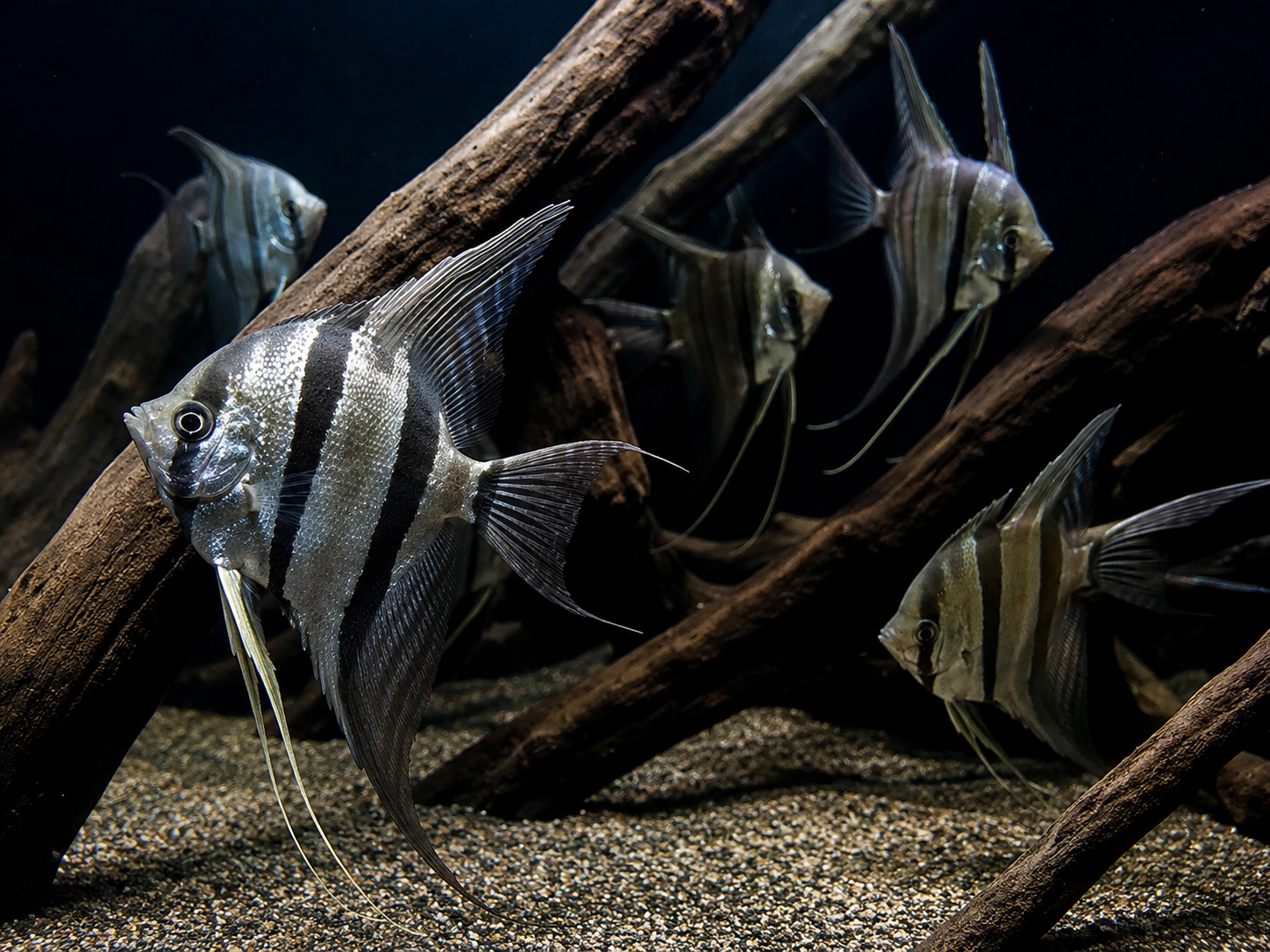
Altum Angelfish are among the most impressive freshwater cichlids available to serious aquarium keepers. Their tall body, long dorsal and anal fins, silver colour and dark vertical bands create a much more dramatic profile than the common domestic angelfish seen in most aquarium shops.
That appearance also causes confusion. A fish with a tall body is not automatically a true Altum. Pterophyllum altum is a separate species from the common Pterophyllum scalare, and fish sold under names such as “Peruvian Altum” are usually not true Altum at all.
Quick answer: true Altum Angelfish are not a sensible first aquarium fish. They suit experienced keepers who can provide a tall, spacious tank, stable soft water, mature filtration, high dissolved oxygen, careful acclimation and a proper social group. Malaysia’s warm climate helps with temperature, but it does not remove the difficult parts of Altum care.
Last reviewed for Malaysia aquarium context: 2026.
Is Altum Angelfish Beginner-Friendly?
| Question | Practical answer |
|---|---|
| Is true Altum the same as a normal angelfish? | No. Pterophyllum altum is a separate species from the common Pterophyllum scalare. |
| Is Altum suitable for a first aquarium? | Usually no. It is sensitive to unstable water, poor acclimation and inappropriate tank size. |
| Does Malaysia’s warm weather make it easy? | No. Warm water still needs stable temperature, strong oxygen exchange and clean water. |
| Can Altum live in a normal small angelfish tank? | Not as a responsible long-term plan. Adult height and group behaviour require much more space. |
| Main challenge | Correct identification, tall-tank planning, soft water, oxygen, acclimation and long-term group care. |
The better question is not “Can Altum survive in my tank?” The better question is:
Can I build the aquarium around the needs of a tall, sensitive, group-living wild-type cichlid?
Akuarium.my does not recommend true Altum as a casual beginner fish.
True Altum Is Not a Colour Variety of Common Angelfish
Freshwater angelfish belong to the genus Pterophyllum. The common aquarium angelfish is usually Pterophyllum scalare, including familiar domestic varieties such as koi, marble, black, gold, zebra and veil-fin forms.
True Altum is Pterophyllum altum. It comes from the upper Orinoco and upper Rio Negro region of South America and has a taller, more vertically stretched profile than most common angelfish.
Useful identification clues include:
- a very tall body with long dorsal and anal fins
- a noticeably concave or notched forehead profile above the snout
- strong vertical dark bands
- a long, narrow overall silhouette
- seller information that clearly states
Pterophyllum altum - credible collection locality or captive-bred lineage information
One visual feature is not enough. Juveniles can be difficult to identify, poor-quality photos can hide the forehead profile, and trade labels are not always used consistently.
A tall angelfish is not automatically a true Altum. Provenance matters as much as appearance.
Be Careful with the Name “Peruvian Altum”
“Peruvian Altum” is a common aquarium-trade name, but it generally refers to a tall-bodied regional form of Pterophyllum scalare, not true Pterophyllum altum.
That does not make Peruvian Altum a bad fish. It can be attractive and may be easier to keep than true Altum. The problem is buying it under the assumption that it has the same identity, origin and care demands as a true Orinoco Altum.
Before paying a premium price, ask the seller:
- What is the scientific name?
- Is the fish wild-caught, F1, captive-bred or a domestic scalare strain?
- What collection locality or breeder line is claimed?
- What pH, GH, temperature and food is the fish currently kept on?
- How long has it been feeding and stable in the seller’s tank?
If the only answer is “Altum type” or “looks like Altum,” treat the identification as unconfirmed.
Adult Size: Height Matters More Than the Number on the Price Tag
Fish references commonly list true Altum at around 18 cm in total body length, but body length does not show the full space requirement. The long dorsal and anal fins can create a total vertical profile of around 30 cm or more in a well-grown adult.
This is why ordinary tank-volume advice can be misleading. A tank may hold many litres but still be too shallow for a tall adult Altum.
The fish needs enough vertical clearance to:
- extend its dorsal and anal fins naturally
- turn without constantly brushing the substrate or surface
- avoid damaged fin tips
- maintain a normal tall swimming posture
- feel secure when moving as a group
For a serious long-term setup, treat around 60 cm of water height as the safer minimum planning point, with approximately 70 cm being better for large adults.
Do not buy juvenile Altum because they fit a smaller aquarium today. Plan the adult tank before buying the fish.
Safer Tank Size and Group Planning
Altum Angelfish should be planned as a group fish, not as a decorative pair placed in a standard community tank.
A small group helps juveniles feel more secure, but it also creates a much larger space requirement. As the fish mature, individuals may form pairs and defend territory. A tank that only looks spacious while the fish are young can become crowded very quickly.
For a proper long-term group, Akuarium.my recommends planning around:
- a six-foot aquarium rather than treating 55 gallons as the normal target
- strong front-to-back depth, not only tank length
- at least around 60 cm of actual water height
- approximately 70 cm of height where possible for large adults
- open swimming room through the centre
- driftwood, tall plants or visual barriers along the sides and back
- enough territory for subordinate fish to move away from a dominant pair
There is no responsible universal rule such as “one Altum per fixed number of litres.” Group size, adult size, tank footprint, filtration and territorial behaviour all matter.
A token pair or trio of unsexed juveniles is not automatically easier. If one fish becomes dominant, the weaker fish may have nowhere to escape. Start only when the final adult aquarium and group plan are already realistic.
Water Parameters: Match the Fish, Do Not Chase One Perfect Number
True Altum are associated with warm, extremely soft and acidic South American waters. That does not mean every aquarium keeper should force the tank to one extreme pH value on the first day.
A cautious planning range for established true Altum is:
| Parameter | Practical planning range |
|---|---|
| Temperature | About 27–30°C |
| pH | Usually around 5.0–6.5 |
| General hardness | Very soft, commonly around 1–5 dGH |
| Ammonia | 0 |
| Nitrite | 0 |
| Nitrate | Consistently low |
| Water movement | Gentle directional flow with good gas exchange |
The correct target also depends on:
- whether the fish is wild-caught, F1 or captive-bred
- the water used by the breeder or importer
- how long the fish has been acclimated locally
- the seller’s current pH, GH, temperature and feeding routine
- whether your source water can be prepared consistently
A stable pH of 6.2 is generally safer than repeatedly moving the fish between 5.0 and 6.5. Do not add random acid products just to make a test-kit number look correct. Rapid changes in conductivity, hardness and pH can be more dangerous than a slightly less extreme but stable value.
If local tap water is hard or alkaline, properly prepared reverse-osmosis or demineralised water may be needed. It should be mixed, remineralised where appropriate, heated and aerated before use. Do not perform large experiments directly in the aquarium.
Malaysia Climate: Warm Water Still Needs Oxygen and Stability
Malaysia’s climate reduces the need to heat a tank from a cold winter temperature, but it does not make Altum care simple.
Warm water holds less dissolved oxygen than cooler water. A tank that remains near 29–30°C therefore needs:
- strong surface movement
- clean mechanical filtration
- mature biological filtration
- sensible stocking
- no accumulation of decaying food
- a backup aeration plan during power interruptions
Air-conditioned rooms create another problem. The tank may be warm during the day, cool significantly overnight, then warm again when the air conditioner is switched off. A reliable heater can still be useful as a temperature stabiliser, even in Malaysia.
Measure the aquarium temperature at different times of day before deciding that no heater is needed. If the tank repeatedly exceeds the intended range, improve room ventilation, surface movement and heat management rather than assuming Altum will tolerate permanently overheated, oxygen-poor water.
Filtration and Water Changes
Altum need efficient filtration, but they should not be forced to fight a harsh current all day.
A suitable system normally includes:
- strong biological capacity
- easily cleaned mechanical media
- a spray bar or directed return that spreads flow across the tank
- visible surface movement
- an intake that cannot damage long fins
- a mature filter before the fish arrive
A large canister filter can work well, but filter size alone does not guarantee safe water. Uneaten food, clogged media, dead plant matter and overcrowding can still raise waste levels.
Small, consistent water changes are usually safer than allowing waste to build up and then making one sudden correction. A practical starting routine is approximately 10–20% once or twice a week, adjusted according to:
- nitrate trend
- feeding level
- group size
- filter maintenance
- source-water stability
Replacement water should be prepared to closely match the aquarium’s temperature and chemistry. For sensitive Altum, a water change should not become a weekly pH and conductivity shock.
Tank Setup
A useful Altum layout combines shelter with uninterrupted swimming space.
Include:
- fine sand or a smooth substrate
- tall pieces of driftwood or vertical roots
- tall plants around the sides and back
- open swimming space through the middle
- subdued or diffused lighting
- a secure cover
- clear areas where every fish can be observed during feeding
Avoid sharp rockwork, rough ornaments and cramped hardscape corridors. Long fins and projecting mouthparts can be damaged when a frightened fish turns quickly.
Blackwater tannins can create a more natural appearance and may help reduce harsh lighting, but tannin colour is not proof that the water is soft or suitable. Test the actual water instead of judging it by colour.
Feeding Newly Imported and Established Altum
Do not assume every Altum will immediately accept flakes or pellets.
Newly imported or wild-caught fish may respond first to familiar moving foods. Useful options can include:
- frozen or live brine shrimp
- mysis
- daphnia
- clean mosquito larvae
- frozen bloodworm as part of a varied diet
- quality small cichlid granules after the fish begins feeding reliably
The goal is not to keep the fish dependent on one live food forever. Once it is eating confidently, introduce frozen and prepared foods gradually.
A practical transition method is to offer a small amount of accepted food together with a high-quality pellet or granule. Remove leftovers before they decay.
Avoid:
- feeder fish with unknown disease risk
- collecting live food from polluted drains or ponds
- feeding only bloodworm
- heavy feeding to “make the fish grow faster”
- leaving food in the tank after a shy group refuses it
A healthy established group should show an alert feeding response without frantic competition or one dominant fish taking everything.
Tankmates: Species-Only Is the Safer Default
The safest starting recommendation for true Altum is a dedicated Altum aquarium.
This makes it easier to:
- quarantine new fish
- observe feeding
- maintain warm, soft water
- reduce competition
- control disease exposure
- manage pair formation and territorial behaviour
Adults can eat fish small enough to fit in their mouth. Neon-sized fish and ornamental shrimp should not be treated as safe companions.
Where a large community setup is attempted, tankmates should be:
- peaceful
- large enough not to be swallowed
- comfortable in the same warm, soft water
- not aggressive feeders
- not fin-nippers
- not constantly active around the Altum group
Do not combine true Altum with random community fish simply because all of them are described as “tropical.”
Buying Checklist for Malaysia
Before buying an Altum from a local shop, importer, breeder or online seller, ask for specific information.
Identity
- Is the scientific name stated as
Pterophyllum altum? - Is it true Orinoco or Rio Negro Altum, or a fish sold as Peruvian Altum?
- Is it wild-caught, F1 or captive-bred?
- Is a collection locality or breeder line available?
Current care
- What temperature, pH and GH is the fish currently kept in?
- What food is it eating now?
- How long has it been in the seller’s system?
- Has it completed any quarantine or observation period?
- Is the entire group feeding?
Condition
Look for:
- steady breathing
- an upright body
- open, undamaged fins
- no repeated flashing or scratching
- no pinched belly
- no unexplained white faeces
- no fish isolated in a corner
- no one individual being continuously attacked
- a visible feeding response
Do not choose only by colour, body height or the seller’s use of the word “rare.” A cheaper well-acclimated captive-bred fish may be a better choice than a stressed wild import with unclear history.
Quarantine and Acclimation
New Altum should not be released directly into an established display aquarium.
Use a separate, fully cycled quarantine setup with:
- matched warm water
- mature biological filtration
- strong aeration
- simple shelter
- easy observation
- enough vertical room for the fish
- no sharp decoration
Quarantine is not only about adding medication. It is a period to confirm that the fish:
- eats consistently
- maintains weight
- passes normal waste
- breathes normally
- shows no developing external signs
- tolerates the intended water conditions
Do not medicate automatically without a reason. Sensitive imported fish can react badly to unnecessary treatment. When disease is suspected, identify the problem and obtain qualified aquatic-veterinary or experienced specialist guidance before using strong medication.
For shipped fish, follow a sensible acclimation method based on the seller’s packing water and transport time. Avoid leaving fish for hours in an opened shipping bag while ammonia becomes more toxic. The objective is to minimise both chemical shock and prolonged exposure to polluted transport water.
Breeding Is Possible, but It Should Not Be the First Goal
True Altum have been bred in captivity, but reliable breeding remains much more difficult than breeding common domestic angelfish.
Successful projects usually depend on:
- a compatible mature pair formed from a group
- very stable, extremely soft water
- low pollution
- suitable vertical spawning surfaces
- minimal disturbance
- careful fry feeding
- patience through failed or eaten spawns
A pair may become strongly territorial. In a tank that is too small, the rest of the group can be trapped away from food or repeatedly attacked.
For most keepers, the first goal should be maintaining a healthy, stable adult group. Breeding should only be attempted after long-term care is already consistent.
Who Altum Angelfish Is For
Altum can suit a fishkeeper who:
- already understands cycling and mature biological filtration
- tests source water rather than guessing
- can prepare soft water consistently
- has space for a tall six-foot aquarium
- is prepared to keep a proper group
- can quarantine new imports
- is comfortable feeding shy or newly imported fish
- accepts that the aquarium must be designed around the species
Who Should Avoid Altum for Now
Choose a more forgiving fish if:
- this is your first aquarium
- the final tank is still uncertain
- your water chemistry changes from one water change to the next
- you cannot prepare soft water where required
- you only want one impressive centrepiece fish
- you plan to mix it with small tetras or shrimp
- you cannot run quarantine
- you are buying mainly because the seller called it rare
Common captive-bred Pterophyllum scalare is a more practical starting point for most fishkeepers who want an angelfish-shaped centrepiece.
Frequently Asked Questions
Is Altum Angelfish suitable for beginners?
Usually no. True Altum require more careful identification, acclimation, soft-water preparation, oxygen management, group planning and tank height than common domestic angelfish.
Is Peruvian Altum a true Altum Angelfish?
Usually not. “Peruvian Altum” is generally a trade name for a tall-bodied form of Pterophyllum scalare. Confirm the scientific name and provenance before paying a true-Altum price.
What tank size does a group of Altum Angelfish need?
There is no safe answer based only on litres. Akuarium.my recommends planning around a six-foot aquarium with strong front-to-back depth and at least about 60 cm of water height. Around 70 cm is better for large adults.
How many Altum Angelfish should be kept together?
Altum are better planned as a proper group than as an unplanned pair or trio of juveniles. The exact number depends on tank footprint and adult territorial space. Do not buy the group until the final adult aquarium is ready.
Does Altum Angelfish need a heater in Malaysia?
It may still need one for stability, especially in an air-conditioned room or where temperature drops overnight. Measure the aquarium across the day rather than deciding from outdoor weather.
What pH is suitable for true Altum?
A practical planning range is usually around pH 5.0–6.5, matched to the fish’s source and acclimation history. Stability is more important than forcing one exact number with acid products.
Is RO water necessary for Altum Angelfish?
Not in every home, but it may be necessary where tap water is too hard or alkaline. RO water must be prepared consistently and remineralised where appropriate. Do not use pure untreated RO water without understanding its chemistry.
Can Altum Angelfish live with Neon Tetras?
Adult Altum may eat small fish. Neon-sized tankmates should not be assumed safe, even if the combination looks natural in a display.
Will Altum Angelfish eat pellets?
Many established fish can learn to accept quality pellets or granules. Newly imported or wild-caught fish may need live or frozen foods first, followed by a gradual transition.
Can true Altum live with common angelfish?
It is possible in a very carefully planned system, but it is not Akuarium.my’s default recommendation. Their origin, water requirements, feeding response, disease exposure and behaviour may differ. A dedicated Altum setup is easier to manage responsibly.
Final Verdict
True Altum Angelfish are not simply taller, rarer or more expensive common angelfish. They are a demanding species that rewards careful preparation and punishes unstable shortcuts.
For a Malaysian keeper, the key question is not whether the room is warm enough. It is whether the aquarium can provide:
- stable soft water
- high dissolved oxygen
- mature filtration
- a genuinely tall tank
- enough space for a group
- careful buying and quarantine
- consistent feeding and observation
When those conditions are already in place, Altum can become the centre of an exceptional South American aquarium. When the tank, water preparation or identification is uncertain, common captive-bred angelfish is the safer and more responsible choice.
Reserved ad space. No third-party ads are currently loaded.
Related Buying Guides
Common Angelfish vs Altum Angelfish: What’s the Difference?
Compare common freshwater angelfish and true Altum by species, body shape, forehead, tank height, water, feeding and suitability for Malaysian fishkeepers.
Read Guide → GuidesArowana Fish in Malaysia 2026: Iconic Fish, Serious Tank Commitment
A Malaysia-focused guide to arowana fish in 2026: why they are popular, how large they get, why tank space and secure lids matter, and whether they suit a home aquarium.
Read Guide →Disclaimer & Guidance Notes:
The specifications, wattages, dimension figures, and platform availability of items mentioned in our guides are based on manufacturer specifications, online store datasheets, and local marketplace data at the time of publication. While we strive to verify all information for reliability, aquarium equipment can vary depending on manufacturer batch updates or specific marketplace suppliers. Ensure you consult with verified sellers or professional fish-keepers prior to configuring heaters, large canister filters, or specialized lighting systems.